The Two Unsung Heroes that Revitalise Your Skin!
Liquid error (sections/article-template line 277): The format option 'month_day_year' is not a supported format.
Juicy Chemistry

Dark spots appeared overnight. Your skin looks patchy, uneven, and tired. Whether from sun exposure, acne, or hormonal shifts, hyperpigmentation frustrates even diligent skincare enthusiasts.
Alpha arbutin works differently. This ingredient can interrupt melanin production at its source, delivering visible clarity without the irritation traditional lighteners cause.
Alpha arbutin targets tyrosinase, the enzyme responsible for melanin synthesis. It acts as a competitive inhibitor, preventing melanin formation without damaging cells or causing rebound darkening when stopped.
Results appear within 4-8 weeks of consistent application. Skin renews every 28-30 days, so visible fading requires multiple renewal cycles.
Alpha arbutin scavenges free radicals, triggering inflammation. This dual-action approach may address current spots and prevent new pigmentation from forming.
Age spots and sun damage develop from cumulative UV exposure. Alpha arbutin targets UV-induced pigmentation by inhibiting melanin production at the cellular level.
Post-inflammatory hyperpigmentation follows acne or injury. Alpha arbutin may prevent melanin overproduction during skin repair, helping marks fade faster than naturally occurring ones.
Melasma involves stubborn, patchy pigmentation. Sustained alpha arbutin serum use proves essential.
Proper application sequence maximises absorption and efficacy.
After cleansing and toning, apply 3-4 drops to face and neck. Follow with a lightweight moisturiser, then a broad-spectrum sunscreen as your final step. Sunscreen is essential because UV exposure directly reverses brightening progress and stimulates new melanin production.
Apply toner, then alpha arbutin serum, then night moisturiser or facial oil. Evening application allows uninterrupted treatment whilst your skin naturally renews during sleep. Consistent morning and evening use delivers measurably faster results than once-daily application.
Alpha arbutin synergises well with vitamin C, which may amplify brightening through complementary antioxidant pathways. Niacinamide may strengthen the skin barrier whilst offering additional tone-evening benefits. Hyaluronic acid may provide hydration that counters potential dryness from active ingredients.
Not all alpha arbutin serums perform identically.
Formulation quality determines stability, absorption, and efficacy.
Look for 2% alpha arbutin concentration, slightly acidic pH between 4.0-5.5, and opaque airless packaging preventing oxidation.
Certified organic formulations with dermatological testing offer additional reassurance, particularly for sensitive skin.
Alpha arbutin can show great results with consistent use.
Week 1-2: Shows baseline establishment with improved hydration.
Week 4-6: Delivers initial visible fading.
Week 8-12: Show substantial spot-lightening.
Beyond 12 weeks: Continued application maintains results and prevents new pigmentation.
Keep some things in mind to see the optimal alpha arbutin results.
Inconsistent application remains the primary obstacle.
Skipping days prevents sustained melanin inhibition needed for fading.
Neglecting sunscreen during treatment may worsen spots because UV exposure stimulates melanin production.
Twice-daily application exists because research confirms this frequency delivers optimal results.
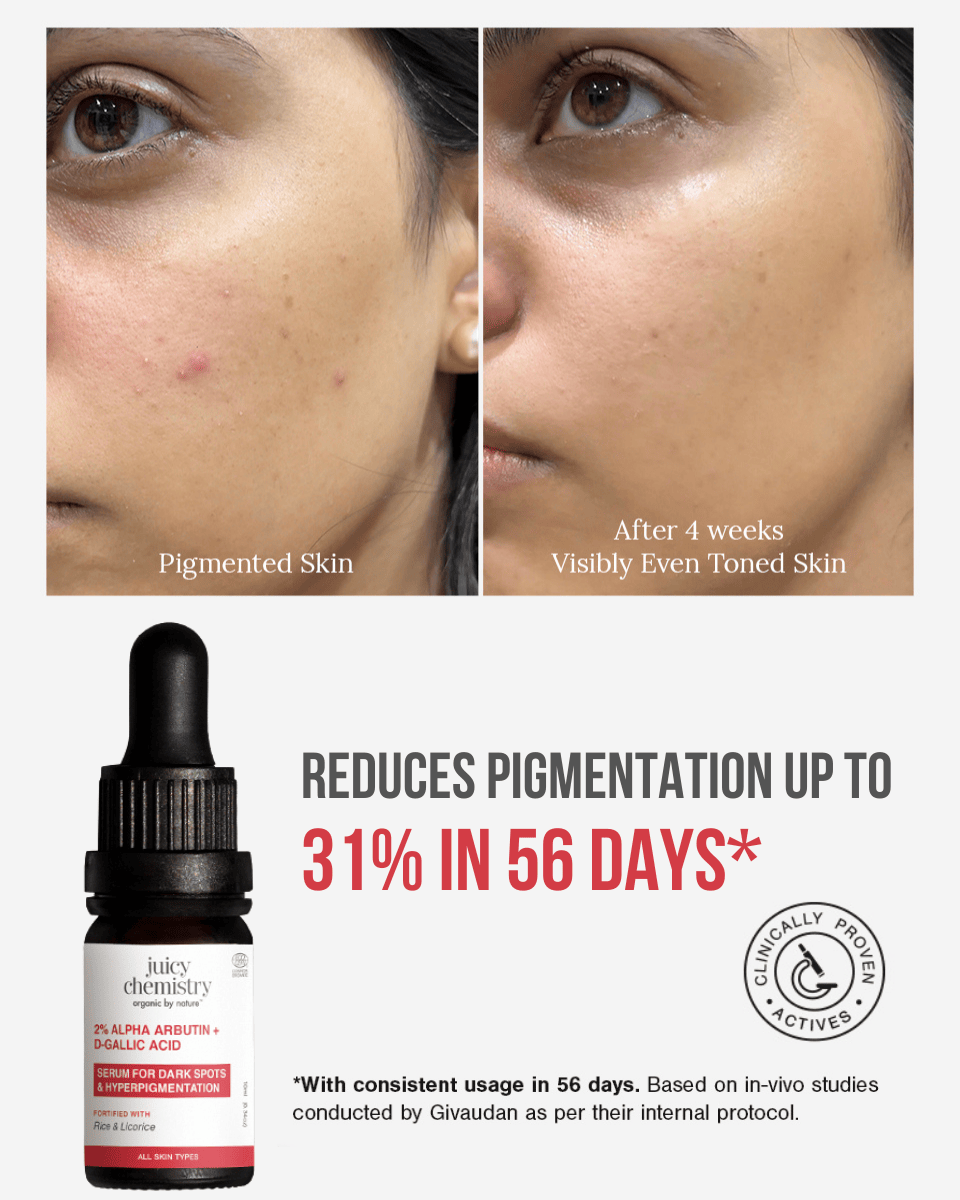
Our formulation addresses practical challenges preventing results elsewhere. The 2% concentration delivers optimal efficacy without irritation. D-gallic acid enhances skin barrier protection and hydration, ensuring suitability for sensitive and reactive skin. Rice and licorice extracts provide antioxidant soothing. The aloe vera hydrating base suits all skin types.
Every ingredient is traceable to certified organic farming with ECOCERT COSMOS certification. Dermatological testing confirms safety for sensitive skin. Apply 3-4 drops after cleansing and toning. Most users see initial fading by week four and substantial results by week twelve. Use morning and evening, following morning application with SPF 50 sunscreen.
Shop our 2% Alpha Arbutin + D-Gallic Acid Serum and achieve clearer, more even skin with clinically proven organic actives. Start your brightening journey today.
Alpha arbutin inhibits melanin production without damaging cells. Hydroquinone carries cytotoxic risks and rebound hyperpigmentation concerns. Alpha arbutin is safer for long-term use.
Yes. Vitamin C and alpha arbutin may work through complementary brightening mechanisms, delivering enhanced results when combined.
Initial fading appears within 4-6 weeks. Substantial improvement develops between 8 and 12 weeks with consistent application.
Yes. It's well-tolerated across sensitive, acne-prone, and compromised skin with minimal irritation risk.
Yes, but sunscreen becomes essential. Daily SPF 50 protects and accelerates results because UV rays trigger melanin production.
Discontinuing doesn't cause rebound hyperpigmentation. Skin maintains improvement. Ongoing sun protection remains important.


Shop Now