Why Sourcing Matters: Unlocking the True Potential of Your Ingredients
Liquid error (sections/article-template line 266): The format option 'month_day_year' is not a supported format.
Juicy Chemistry

For years, deodorants have tried to solve body odour by doing one of two things: blocking sweat or masking smell. Neither addresses the real cause.
The Reality of Sweat:
Sweat itself is odourless. Odour only forms when sweat interacts with bacteria on the skin, particularly in warm, occluded areas like the underarms. Once you understand this, the solution changes from a "cover-up" to a "correction."

Underarms are unique skin zones that create a perfect breeding ground for odour-causing bacteria because they are:
Traditional antiperspirants use aluminium salts to block sweat glands, while perfumes mask odour temporarily. Neither approach improves the skin’s biological environment.
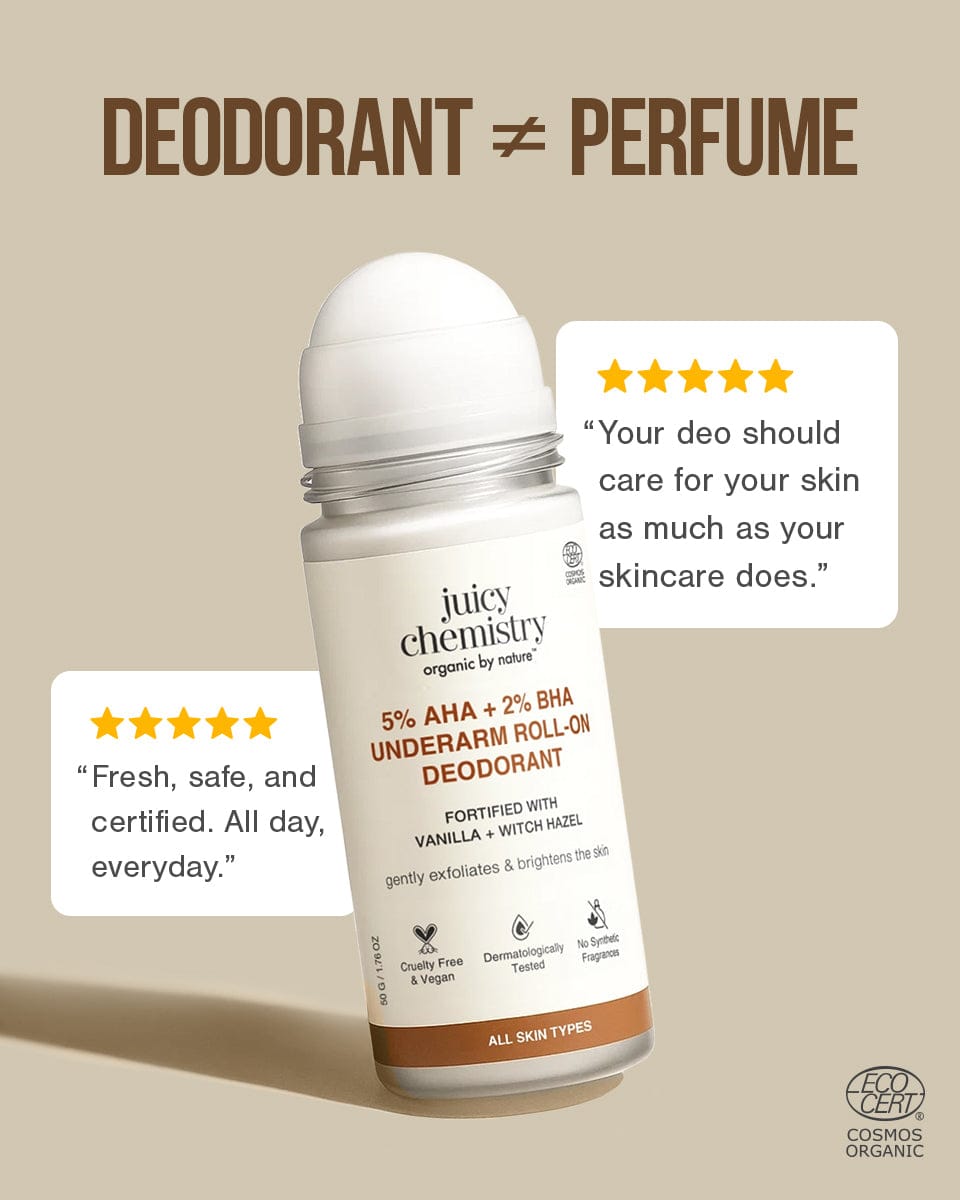
While AHAs (Alpha Hydroxy Acids) and BHAs (Beta Hydroxy Acids) are famous for facial care, their role in underarm care is incredibly logical.
Key Takeaway: Less bacteria means less odour. This is correction, not masking.
Sweating is a natural, necessary process for temperature regulation and waste removal. Blocking sweat doesn't address bacteria; it simply traps moisture, which can lead to irritation or "rebound odour."
An AHA + BHA Deodorant allows the body to sweat naturally while eliminating the conditions that cause smell. The skin functions as it should—just in better balance.
In this formulation, Vanilla isn't just a masking note. It serves a functional purpose:
What to Expect: The Transition
|
Timeline |
What You May Experience |
|
Initial Use |
Mild tingling or a slight warming sensation as the skin adjusts to actives. |
|
With Consistency |
Reduced body odour, a fresher feel, and smoother underarm skin. |
|
Safety Tip |
Avoid applying immediately after shaving or on broken skin. |
Usage & Compatibility

Body odour isn’t something to hide; it’s feedback from the skin. When you rebalance the pH and reduce bacterial load, odour reduces on its own. Balanced skin simply performs better.
Q: Why do acids help with underarm odour?
A: Odour comes from bacteria breaking down sweat. Lowering skin pH and clearing dead skin makes the environment less hospitable for those bacteria, rather than simply covering the smell.
Q: Will an AHA and BHA deodorant sting?
A: On intact skin it should not. Avoid applying immediately after shaving or waxing, when the skin barrier is temporarily compromised.
Q: Can it help with underarm darkness?
A: Gentle exfoliation may help with dullness caused by build-up, though pigmentation from friction or shaving takes longer and needs the trigger addressed too.
Q: How is this different from an antiperspirant?
A: An antiperspirant blocks sweat with aluminium salts. This works on the odour-causing bacteria instead, so you still sweat normally.


Shop Now